The hurricane comes ashore on the first of September. By the following Tuesday the claims team has paid $25 million on one insured, a cold-storage operator with three warehouses on the coast. The claims system is doing its job. The ceded desk now has its own list, and nobody hands it over: tell the cat panel before they read about it, call the reinsurers’ share of a paid loss rather than wait for the quarter, work out the reinstatement premium the carrier now owes, put all of it on the month’s statement, and chase whoever is late.
On most desks each of those is a spreadsheet and an email, and the order they happen in depends on who is on holiday. This post follows one loss through InsightCede from the claim payment to the cash, with the figures at each step and the point at which a person answers. It is the scenario the product is built and tested against.
What happens before anyone looks
InsightCW reports the payment as an event: claim.payment_issued for claim CLM-2041,
property, loss date 1 September, gross paid $25,000,000. The event carries the claim’s whole
position, not the movement, and the deterministic engine works out what changed.
The engine walks the contracts in force on the loss date in their inuring order. The casualty quota share is considered and passed over: it does not cover property. The property catastrophe excess of loss, BAY-CAT 2026 on a losses-occurring basis, responds. Its first layer is $10 million excess of $15 million, so a $25 million loss fills it exactly; the second layer attaches at $25 million and is not reached. Because the layer is an occurrence cover, the engine would also add every other claim tagged with the same cat code inside the treaty’s hours clause and share the layer between them pro rata to their loss. Here the hurricane’s loss to the layer sits on one claim.
In the same transaction it writes what follows from the cession. The $10 million is paid, so it becomes recoverables split by signed line to the cent: $7,000,000 from Big Re, the 70% lead, and $3,000,000 from Small Re. The layer has used its one reinstatement, so the engine raises reinstatement premium: the $800,000 layer premium, times the share of the limit reinstated (all of it), times the unexpired part of the treaty year at the loss date (0.3324), at 100% — $265,920. Then it commits.
Only after the commit do the agents run. The intake calls a post-commit hook with the event id; the agents open their own session and read the rows the engine wrote. No agent computes a cession, and none can see one half-written.
sequenceDiagram
    participant CW as InsightCW
    participant E as Cede engine
    participant A as Agents
    participant P as Priya, analyst
    participant T as Tom, head of RI
    participant R as Big Re and Small Re
    CW->>E: claim.payment_issued, CLM-2041, paid $25M
    E->>E: cede $10M to layer 1, raise $7M and $3M, raise $265,920, commit
    E-->>A: after_ingest, post-commit
    A->>A: cession explained and noted, no anomaly
    A->>P: notice, cash call, reinstatement notice, held at L2
    P->>A: accept, accept, accept
    A->>R: released from the held outbox to Big Re
    P->>E: bill the claim, due in 30 days
    A->>T: strike the September bordereaux
    T->>A: accept, then accept the send
    A->>P: firm chaser to Big Re, 31 days late
    P->>A: accept
    R->>P: payment
    P->>E: record the collection
Three drafts waiting on Tuesday afternoon
The first agent to run is the cession decision agent. It writes the account of the event: BAY-CAT 2026 responded on layer 1, the quota share did not cover property, the engine’s own note. Because the cession is clean, the record is noted on the event — kept, not queued. The anomaly explainer looks for a double cession, a short panel or an uncovered remainder and finds none. Neither puts anything in front of a person.
Three things do arrive in the queue, each a decision record at L2, Ask first:
- The large loss notice. $25 million gross is over the configured large-loss threshold, so the agent drafts the notice to the panel of every contract the claim touched, with the claim facts and the layer reached. Big Re has a claims contact on file. Small Re does not, and the draft names it rather than guessing an address.
- The cash call. $10 million is now recoverable on the claim, far above the $250,000 cash-call threshold. The draft lists each reinsurer’s share: $7,000,000 and $3,000,000.
- The reinstatement notice. The agent reads the premium the engine raised and checks the layer: one reinstatement used of one allowed, within the allowance. It drafts the notice for $265,920.
Every message is written held in the outbox. Nothing reaches a reinsurer until a person accepts, and outside production nothing leaves at all — the dry-run provider records it.
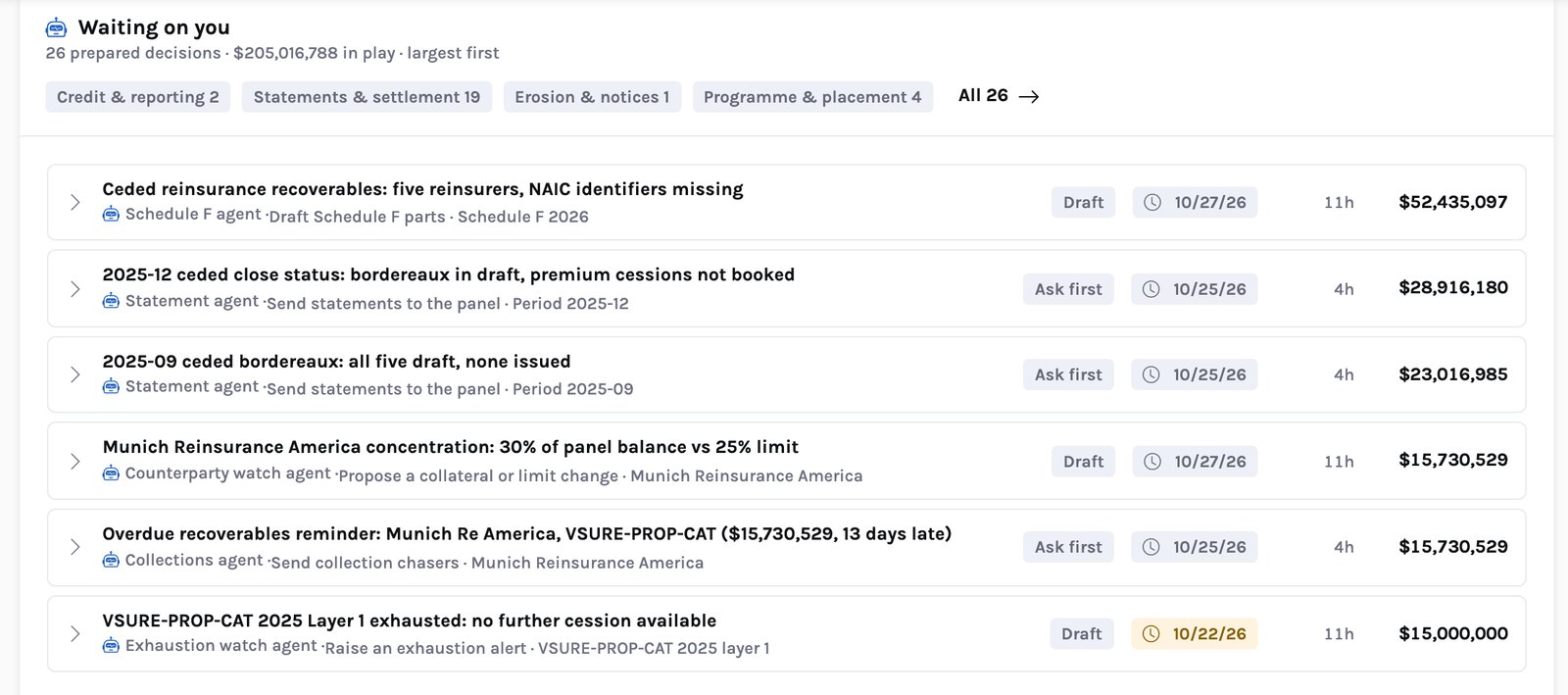
The use case, in one table
| One cat loss, end to end | |
|---|---|
| Trigger | A claim event from InsightCW (here claim.payment_issued) after the engine commits; month end for the statement; a recoverable past its due date for the chaser |
| Actor(s) | The ceded reinsurance analyst (notices, cash call, chaser, billing, collections); the head of reinsurance (the period’s statements) |
| Agents | Cession decision, anomaly explainer, large loss notice, cash call, reinstatement, statement, collections |
| Grounded in | The event and the engine’s note; loss cessions; the claim register; recoverables; reinstatement premium rows; the layer’s reinstatements; the panel and contact_email; bordereaux; Pulse news on the reinsurer |
| Prepares | The cession explanation (noted); a notice, a cash call and a reinstatement notice, each held; a strike proposal, then a send proposal; a chaser in the tone its age deserves |
| Checkpoint & default level | cession_review L2 (a clean cession is noted, not asked); notice_send, cash_call_send, reinstatement_send, statement_strike, statement_send, chaser_send all L2; the tenant ceiling is L2 |
| What a person decides | Whether each message goes, as drafted; whether the period’s bordereaux are struck and sent; when to bill; what was collected |
| What is recorded | A decision record per draft (evidence with its source table, proposal, prompt version, model, cost, trace); the answer as feedback; the outbox row held, released or cancelled; every agent-written row stamped agent:<code> |
What a chaser looks like when it arrives
The record a person answers is the same shape for every agent: the recommendation in one line with the money, the explanation, the evidence grouped by the ledger table it came from (the worrying items first, each one a link into the ledger), the draft as it will be sent, and four answers — Accept, Change, Reject, Ask.
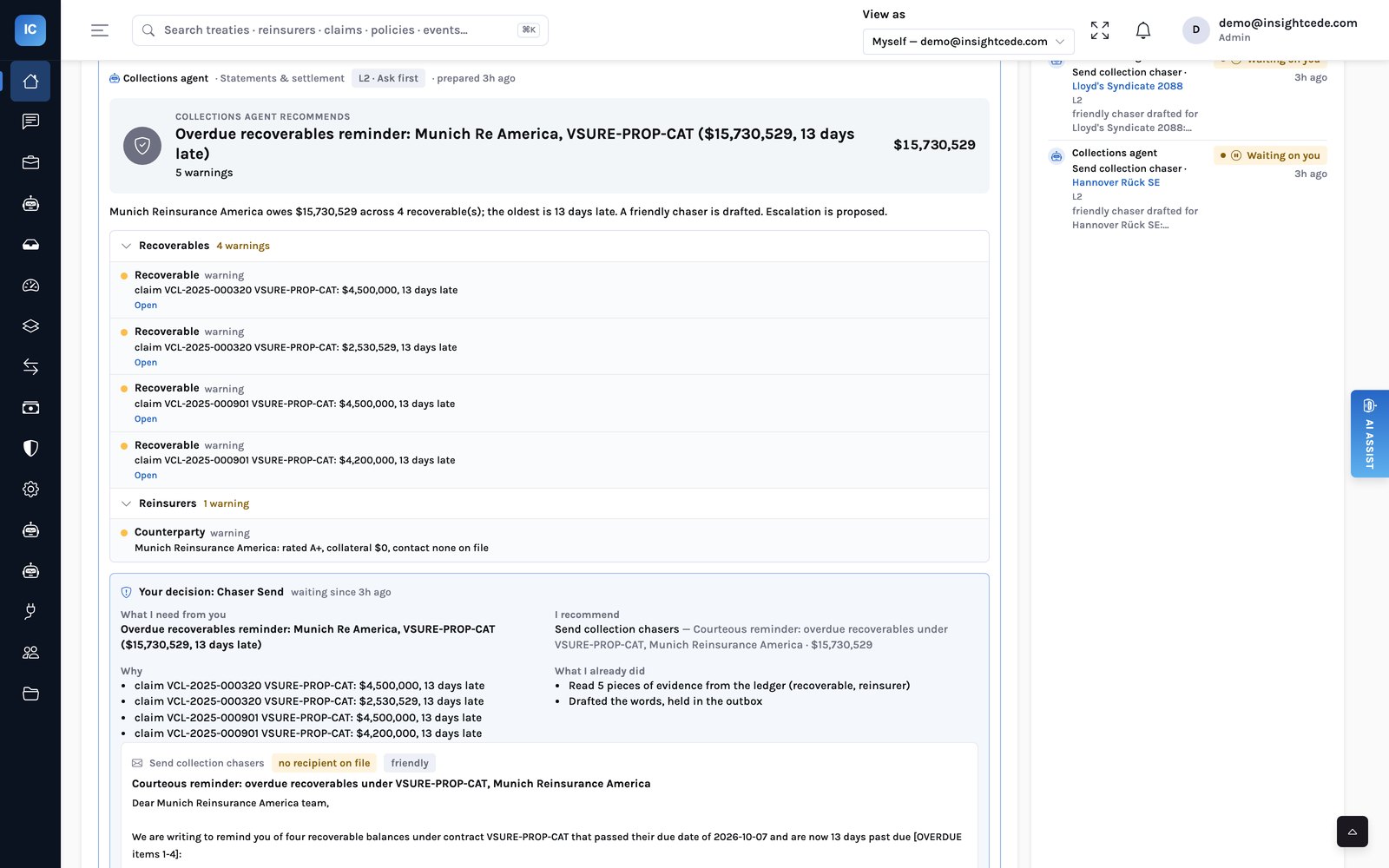
The tone is not the model’s choice. The collections agent sets it from the oldest item’s age — friendly up to 30 days late, firm to 90, a final notice beyond — and the model writes the words to that tone over the recoverables it was given. If the model cannot be reached, the record says the explanation was not written by it, and the evidence stands on its own.
What the answers are for
Each of Priya’s and Tom’s answers is recorded as feedback against its checkpoint. A roll-up on the housekeeping schedule counts agreement. When a checkpoint reaches 90% agreement over at least 50 answers on a line of business, the roll-up recommends promoting it; a manager accepts the recommendation, and it cannot go above the tenant ceiling, which is L2 until the carrier raises it. Below 70% over 20 answers it demotes at once, with managers told. So after a season of property chasers accepted as drafted, the next one could go at L3 — sent with a one-hour pull-back window and a notice to the analyst — and nothing else about the flow changes. The kill switch drops an agent back to L1 everywhere, at once.
Why the clean cession is not in the queue
Every inbound event gets a cession decision record, but a clean one is noted rather than asked. A ceded desk that has to acknowledge each of a thousand routine cessions stops reading them; the queue is for the refused, the uncovered and the odd. The record is still there on the event, with the contracts in inuring order and why each did or did not respond, for anyone who asks later.
What it does not do
- It does not move money. Billing the recoverables and recording a collection are ledger writes a person makes, behind a confirmation that states the amount. Accepting the cash call sends the call; it does not bill.
- A Change is recorded, not re-sent. Change edits the proposal on the decision and counts as feedback, but today the held message is released as the agent drafted it. To send different words or to different people, reject the draft and send your own.
- No contact means no addressee. Small Re appears in every draft by name with no contact on file. The fix is a contact on the reinsurer record, not a guess — and until then that copy is sent by hand.
- The thresholds are configuration, not wording. The large-loss and cash-call thresholds ($1,000,000 and $250,000 by default) are set per carrier until treaty wordings are stored, so the drafts do not cite a clause.
- The statement does not know about the cash call. The bordereau is struck from the cessions, so September’s account shows the $7,000,000 paid loss that the cash call already asked for. Reconciling the two is still the analyst’s.
- The agents explain what the engine committed. If a figure in the ledger is wrong, the record explains the wrong figure fluently. The evidence links are there so a person can check the row.
Each step has its own post in this series — the notice, the cash call, the reinstatement premium and the period close — with the rules behind it. If your last cat loss was run from a spreadsheet and a shared mailbox, bring its figures and we will walk them through the same quarter.