The first working day of the month. The ceded desk owes every reinsurer on every treaty an account for the month just ended: the premium ceded, the commission allowed, the paid losses they owe back, and the balance that says who pays whom. On a spreadsheet desk that is a pivot table per treaty, cut by signed line, pasted into a template and emailed. Then, on the ninth, an endorsement dated the twenty-eighth turns up from underwriting. Someone reopens the pivot, the statement is re-sent, and two reinsurers now hold two versions of the same month.
The work is mechanical, and the hard part is not the arithmetic. It is the promise: once a statement has gone to a reinsurer, the number on it must not move underneath them. This post is about how InsightCede keeps that promise, and which parts of the close an agent prepares.
Four rules the ledger keeps
| Rule | What it means in practice |
|---|---|
| Struck per reinsurer, from the ledger | One bordereau per treaty per reinsurer for the period, from the premium, loss and reinstatement premium cessions booked to it, each allocated on the panel of the layer it sits on, to the cent, with the odd cent on the lead. A facultative certificate is its own statement. |
| Only paid loss is on the account | Balance = premium + reinstatement premium − commission − paid loss. Positive is owed to the reinsurer, negative is owed to the carrier. Outstanding loss is reported beside the account and never netted: nothing is owed on a reserve. |
| An issued statement never changes | Striking again replaces drafts and leaves issued statements alone. Issuing freezes the statement and records who sent it. |
| A closed period takes nothing new | Closing is an explicit act, refused while any draft for the period is unissued. A cession dated inside a closed month is booked to the next open period, where the next statement picks it up. |
Cessions are append-only, so the last rule is what makes the others hold. A correction is a contra row, never an edit, and a late item lands in a month that has not yet been reported. The statement the reinsurer is settling against is the statement the ledger still agrees with.
What the statement agent prepares
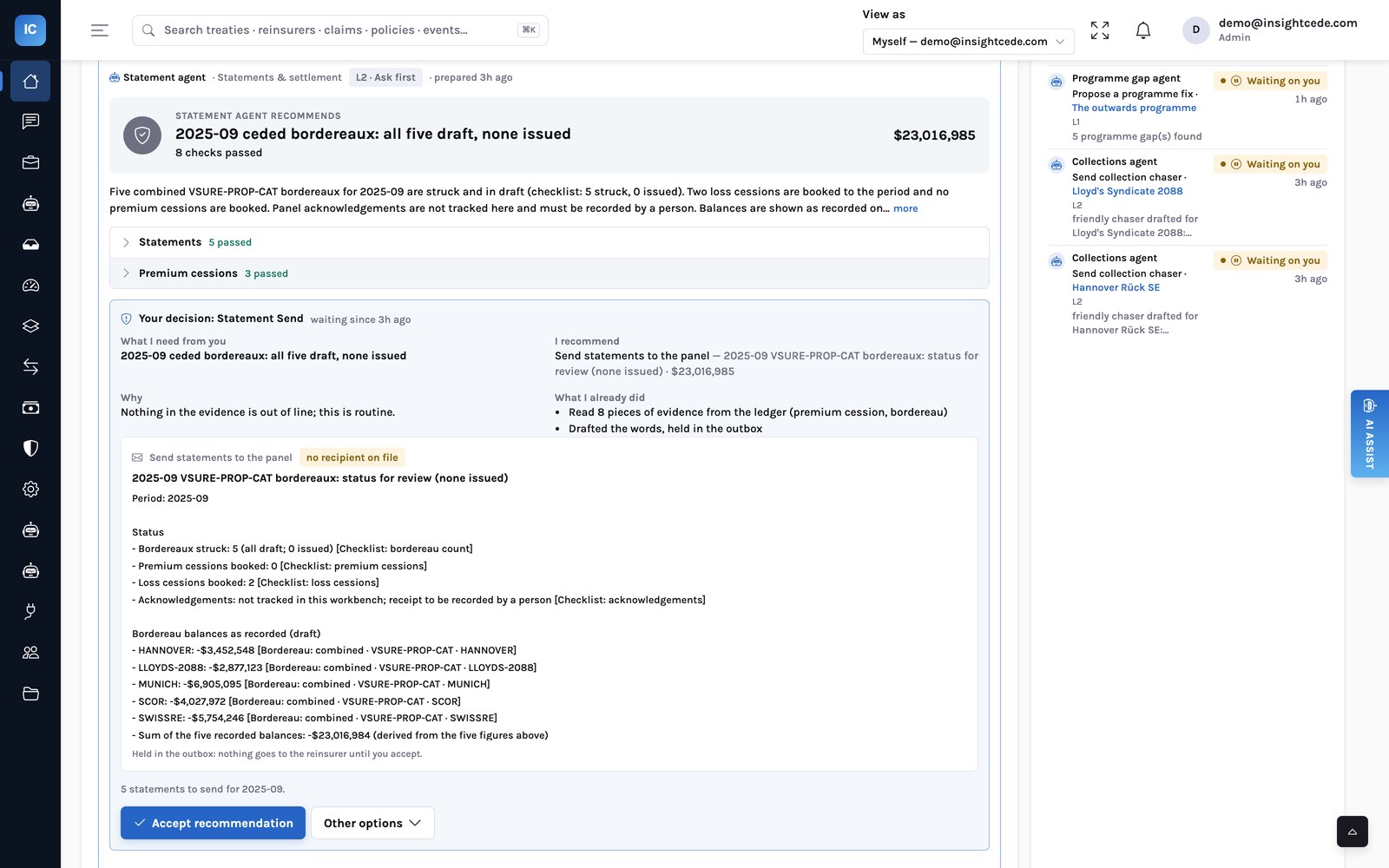
Every six hours the statement agent looks at each month before the current one that has cessions booked to it. If no bordereaux have been struck for the month, it proposes striking them. If drafts exist, it proposes sending them. Each proposal is a decision record at L2, Ask first, with the month’s checklist as evidence: how many premium and loss cessions are booked to it, how many bordereaux are struck and how many of those are issued, and a plain line that acknowledgements are not tracked yet.
Accepting a strike calls the bordereau service, which strikes the drafts from the ledger. Accepting a send issues each draft — frozen, sender recorded, the desk and managers notified — and releases the covering note from the held outbox to the reinsurers with a contact on file. The agent never computes a balance; its definition says it never invents one.
flowchart LR
    A["Month ends"] --> B["Agent proposes
strike, L2"]
    B -- accept --> C["Drafts struck
per treaty, per reinsurer"]
    C --> D["Agent proposes
send, L2"]
    D -- accept --> E["Issued and frozen
note released"]
    E --> F{"Manager closes
the period"}
    C -. close tried early .-> R["Refused
drafts not issued"]
    F --> G["Late cession dated
in the closed month"]
    G --> H["Booked to the
next open period"]
On the demo ledger
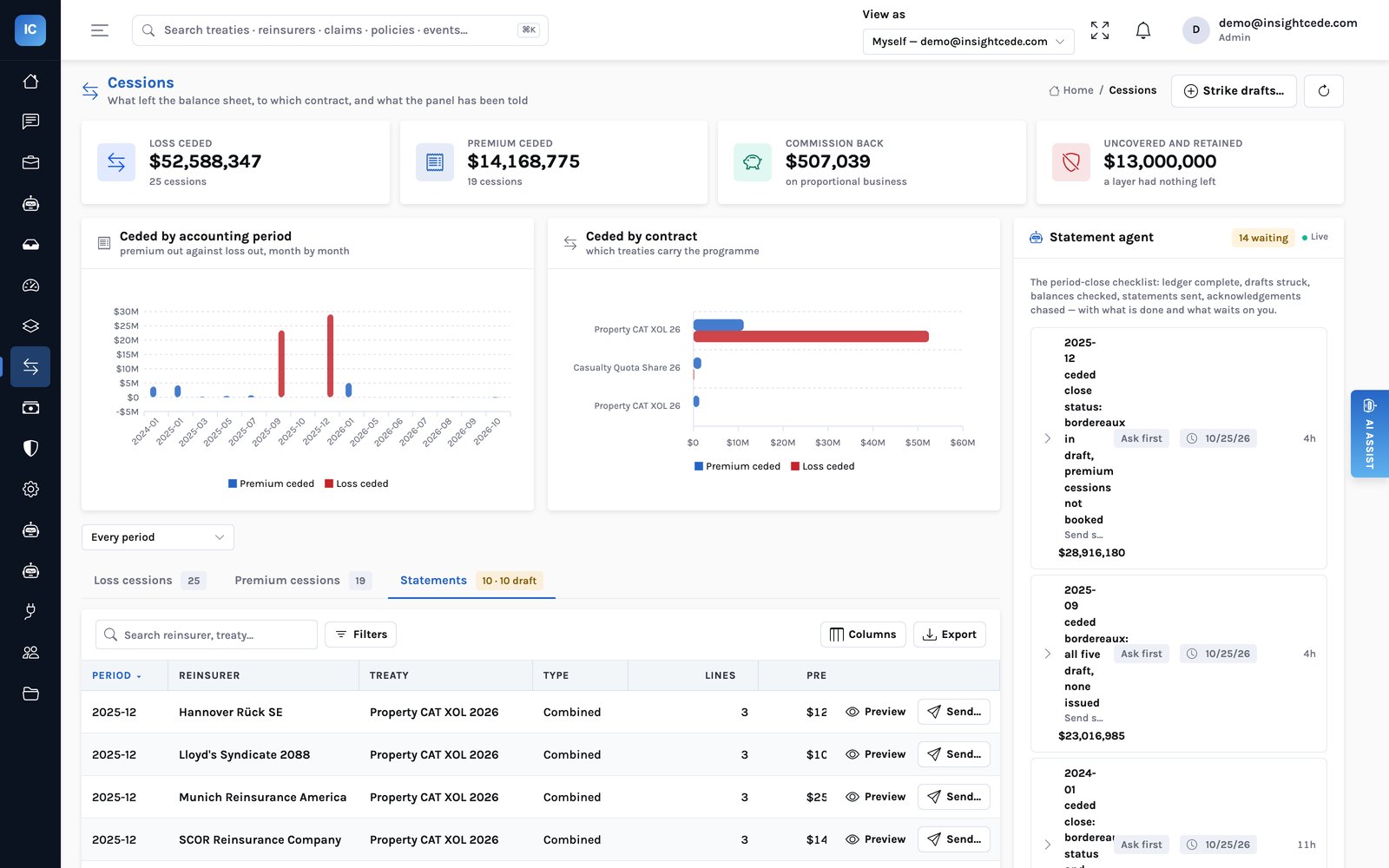
The demo queue shows the agent at work on a ledger nobody has closed. It holds fourteen statement decisions: twelve months with cessions and no bordereau, each with a strike proposal, and two months with drafts waiting to be sent. September 2025 has five drafts on the cat treaty, one per reinsurer on the panel, from Munich Re America’s −$6,905,095 to Lloyd’s Syndicate 2088’s −$2,877,123, together −$23,016,984.79; December 2025 has five more, together −$28,916,180. Every balance is negative — owed to the carrier — because the months carry paid cat losses and no premium booked to them.
Two details in those records are worth noticing. The model’s explanation says the sign convention is not stated in the evidence it was given, so it reports the balances as shown rather than interpreting them; the screen states the convention beside every balance. And the recipient list is empty: no reinsurer on the demo panel has a contact on file, so issuing would freeze the statements and send nothing.
The use case, in one table
| One accounting period, closed | |
|---|---|
| Trigger | Scheduled, every six hours: a month before the current one with cessions booked and no bordereaux (strike), or with drafts (send) |
| Actor(s) | The head of reinsurance or ceded manager; the analyst who checks the drafts |
| Agent | Statement agent |
| Grounded in | Bordereaux by period and status; premium and loss cessions by accounting period; the bordereau service; reinsurer contacts |
| Prepares | A strike proposal with the month’s checklist; then a send proposal listing the drafts to issue, with a covering note held in the outbox |
| Checkpoint & default level | statement_strike · L2 and statement_send · L2 |
| What a person decides | Whether to strike and whether to send; when to close the period (a manual act on the Cessions screen); whether to reopen one |
| What is recorded | Each decision with its checklist; the bordereaux as struck and issued, with who issued them and when; the period’s status, who closed it and when; the outbox row for the note |
The statements, in one list
The Statements tab on Cessions is the bordereaux by period: treaty, reinsurer, type, record count, premium, loss, commission, the balance with its sign explained, and where each one stands. The statement agent’s period-close steps sit in the rail beside it, and under them the accounting periods, open or closed, each with its Close or Reopen action behind a confirmation that says what closing will stop.
A late item is added to a month already reported. The statement is regenerated and re-sent; the reinsurer has to work out which version it is settling and why they differ.
The issued statements are frozen and the month is closed. The late item is booked to the next open month and reported there, so every statement a reinsurer holds still agrees with the ledger.
Close after you send, not later
The statement agent works by calendar month: once September is over it proposes the strike, whether or not anyone has closed the period. Closing is separate, and it matters. A late cession that arrives while September is still open lands in September; if September’s statements are already issued, striking again leaves them alone and the agent sees no drafts to send, so that item is on no statement until someone notices. Closing the month as soon as its statements are issued is what sends the late item to October.
What it does not do
- It does not close the period. Strike and send are prepared; the close is a manager’s act on the Cessions screen, and the agent does not propose it.
- It does not track acknowledgements. The checklist says so in every record: whether the reinsurer received and agreed the statement is recorded by a person, if at all.
- Issued is not the same as delivered. Issuing freezes the statement. The covering note goes only to reinsurers with a contact on file, and only when production delivery is on; on the demo panel, with no contacts, nothing would be sent.
- It does not net cash calls. The account is struck from the cessions, so paid loss already called in cash still appears on the month’s statement.
- It skips treaties with no panel. Cessions to a treaty with no participations are listed as skipped, not allocated — the programme gap agent is the one that flags the missing panel.
- Reopening is allowed. A manager can reopen a closed month for a correction. Statements already sent are not changed, but new items will land in it again until it is closed.
If month end on your desk still ends with a re-sent statement, bring one month’s cessions and we will strike, send and close it with you.