The broker’s email arrives in October: the 1/1 submission is due in three weeks, please send updated loss experience, the reinstatement premium paid, the panel as it stands and the exposure data. The head of reinsurance forwards it to the ceded analyst, who spends the best part of two days pulling five years of cessions out of the ledger by treaty year, reconciling them to last year’s submission, and finding that the reinstatement premium paid after the hurricane is in the general ledger and not in the cession history. The exposure data is a different team’s problem, and that team hears about it last.
None of the ledger part of that needs two days. It needs someone to have started before the email arrived.
What the agent assembles
Every twelve hours, in the programme step, the renewal prep agent looks for treaty years that are active and expire within the renewal window — ninety days by default, set by the carrier. For each one it builds a pack:
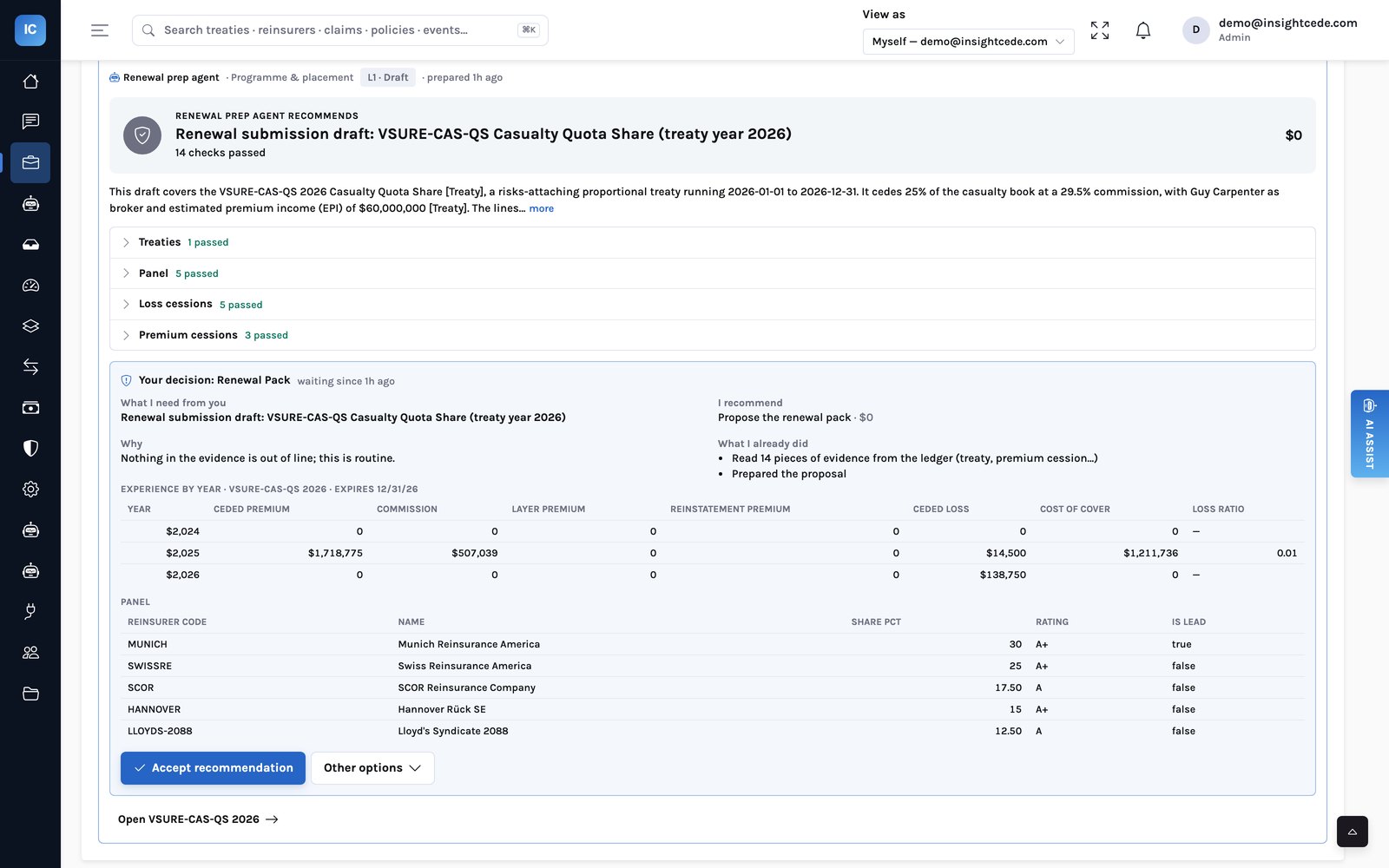
- Experience by underwriting year, for every year of the same treaty code on the ledger: premium ceded, ceding commission back, layer premium for an excess treaty, reinstatement premium, ceded loss, the cost of cover (premium less commission plus reinstatement premium, or layer premium plus reinstatement premium on an excess treaty), and ceded loss as a ratio of that cost.
- The layers of the expiring year: limit and attachment, lifetime capacity with the reinstatements the contract grants, what is eroded, reinstatements used, the rate on line and the layer premium.
- The panel: each reinsurer, its signed share, its AM Best rating, and the lead.
- The largest losses on the expiring year, up to five, by ceded amount.
- What is missing, always the same two lines: the exposure profile (limits and aggregates), which Cede never receives, and market pricing.
If a model is reachable it writes a narrative over those figures and a list of asks: what the reader should confirm before the pack is used. Its catalogue entry forbids it to invent exposure the ledger never received or a market price. If it is not reachable, the pack is the figures and a one-line summary, and the record says the model did not write it.
gantt
    title A 1 January treaty year, with a 90-day window
    dateFormat YYYY-MM-DD
    axisFormat %d %b
    todayMarker off
    section Cede
    Renewal window opens        :milestone, m1, 2026-10-02, 0d
    Pack prepared, refreshed every 12 h :a1, 2026-10-02, 2026-12-31
    section The market
    Submission to the broker    :milestone, m2, 2026-10-30, 0d
    Quotes and negotiation      :a2, 2026-11-02, 2026-12-15
    Firm order and signing      :a3, 2026-12-15, 2026-12-31
    Renewal                     :milestone, m3, 2026-12-31, 0d
Each refresh compares the new pack with the waiting one. If nothing material has changed the waiting decision stays; if a loss has been ceded or a reinstatement premium raised in between, the old pack is superseded by the new one. So the pack the head of reinsurance opens in November is the ledger as it stands in November, not as it stood when the window opened. Answering a pack does not stop the refresh: once it is answered it is no longer waiting, so the next run prepares a new one, which then waits until something changes or it expires after fourteen days.
Use case details
| Renewal pack | |
|---|---|
| Trigger | Scheduled, every 12 hours (the programme step), for each active treaty year expiring within the renewal window (90 days) |
| Actor(s) | Head of reinsurance; ceded analyst; the broker who receives the submission; the exposure owner in underwriting |
| Agent | renewal_prep_agent, action renewal_pack |
| Grounded in | cede_treaty and cede_treaty_layer, premium and loss cessions by treaty year, cede_reinstatement_premium, cede_participation and cede_reinsurer |
| Prepares | Experience by year, cost of cover, layers and erosion, panel and ratings, largest losses, a narrative, asks, and what is missing |
| Checkpoint & default level | renewal_pack at L1 Draft |
| What a person decides | What goes into the submission, how the bad year is presented, which panel changes to seek, and when the exposure data is chased |
| What is recorded | The run, the pack with every figure as evidence, the answer and any change as feedback |
The demo programme’s cat renewal
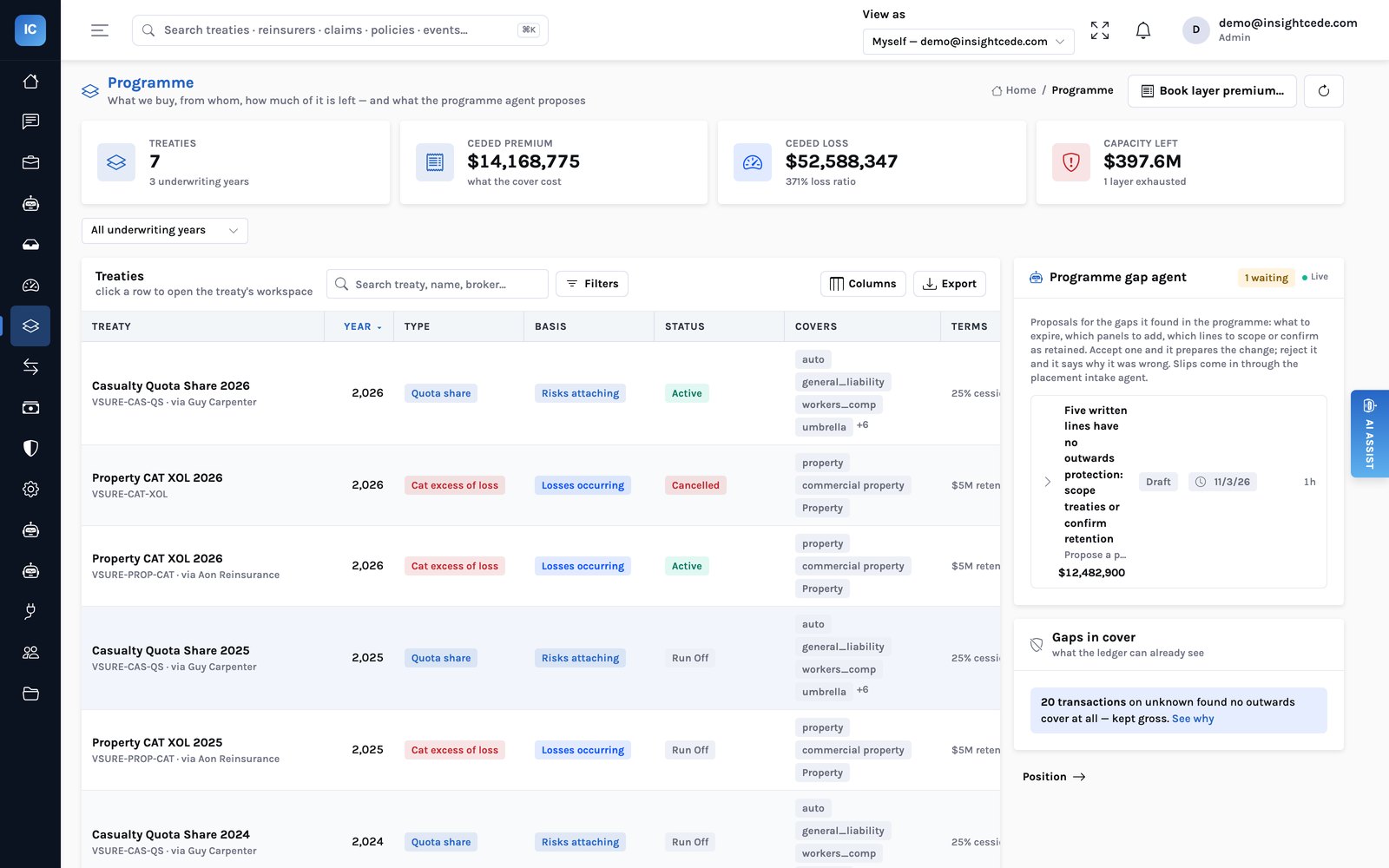
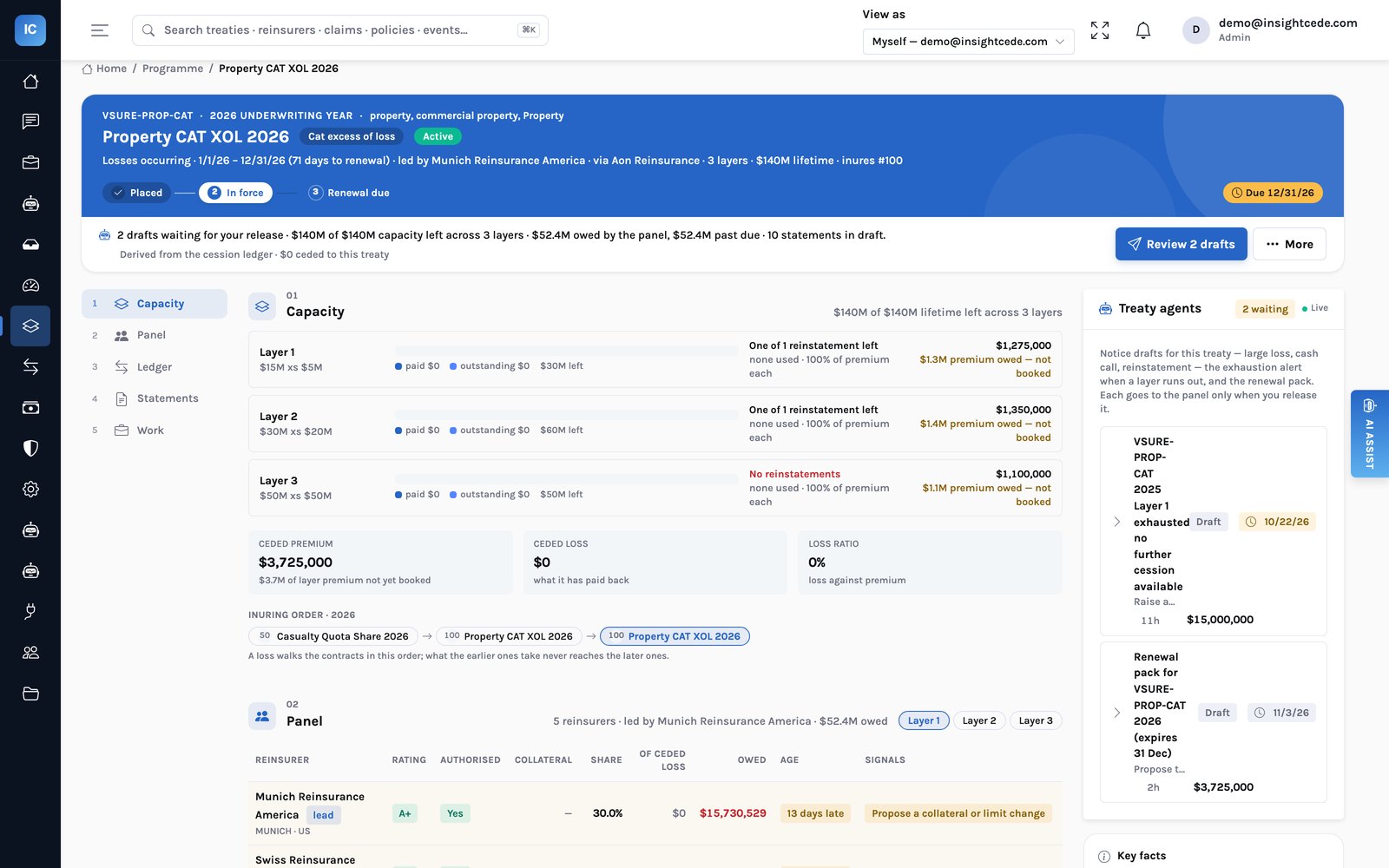
The demo ledger’s property catastrophe excess of loss expires on 31 December 2026, inside the window, and its pack is in the queue at the cost of cover for the expiring year. It is a three-layer tower with a five-reinsurer panel led on a 30% line. Here is the experience it assembled, figure for figure:
| Treaty year | Layer premium | Reinstatement premium | Cost of cover | Ceded loss | Loss / cost |
|---|---|---|---|---|---|
| 2024 | $3,725,000 | $0 | $3,725,000 | $0 | 0% |
| 2025 | $3,725,000 | $724,929 | $4,449,929 | $52,435,097 | 1,178% |
| 2026 | $3,725,000 | $0 | $3,725,000 | $0 | 0% |
| Layer (2026) | Limit xs attachment | Reinstatements | Lifetime capacity | Layer premium |
|---|---|---|---|---|
| 1 | $15,000,000 xs $5,000,000 | 1 | $30,000,000 | $1,275,000 |
| 2 | $30,000,000 xs $20,000,000 | 1 | $60,000,000 | $1,350,000 |
| 3 | $50,000,000 xs $50,000,000 | 0 | $50,000,000 | $1,100,000 |
The 2025 line is the one the market will price on: two catastrophe losses ceded $52.4M against a year that cost $4.45M, of which $724,929 was reinstatement premium for limit put back after the losses. A third loss that year exhausted layer 1 and left $13M retained. The pack has all of that because the engine booked it; nobody had to find the reinstatement premium in the general ledger.
The casualty quota share in the same demo shows what the asks are for. Its model narrative noticed that the 2025 loss ratio was printed as 1% when the figures give about 1.2%, that 2026 shows $138,750 of ceded loss against a cost of cover of $0, and that there is no valuation date on the 2026 figures. It asked for each to be confirmed rather than smoothing them over. The $0 is real: 2026 premium cessions on that treaty had not been booked, which is a question for the period close, and exactly the kind a broker would otherwise find first.
The panel table is worth a minute too. It carries each reinsurer’s signed share and its AM Best rating as the reinsurer master holds them today, not as they were at the last renewal, so a reinsurer that has slipped since January is visible at the moment its line is renegotiated. What the pack does not do is pull in the counterparty watch: a concentration or collateral concern on the same reinsurer is its own decision in the same queue. In the demo, the 30% lead on this tower is also the reinsurer the counterparty watch has flagged for holding 30% of everything the panel owes — two records, one conversation with the broker.
What it does not do
- It has no exposure data. The limits profile, aggregates by zone and anything modelled from them come from underwriting and the cat modelling team. Cede never receives them; the pack says so on every run.
- It has no market view. No pricing, no rate change, no commentary on capacity. Those are the broker’s.
- Its experience is the ledger as booked. Ceded losses are paid plus case reserves as the claims system reported them. There is no IBNR, no development, and no as-at date on each year, which is why the model asks for one.
- The detail is the expiring year’s. The layer table and the largest losses come from the treaty year that is renewing. A bad prior year appears as a line of experience, not as named losses — in the demo, the 2025 catastrophe losses are in the experience table but not in the largest-loss list, because the 2026 year has none.
- A repeated panel. On a layered treaty the panel list in this build repeats once per layer; the demo’s five reinsurers appear three times. The shares are right; read one set.
- It is a record, not a document. Nothing is rendered as a submission and nothing is sent to the broker. Accepting records that the pack was reviewed.
Why the missing list never changes
The two lines — exposure, market pricing — are on every pack because they are the two inputs a renewal cannot do without and the ceded ledger cannot hold. Saying so on the first day of the window is worth more than any narrative the model writes: it is the line that gets the exposure team started in October rather than December.
If your renewal submission still starts with a request to the ceded team to pull the experience, bring last year’s submission and we will show you the pack the ledger would have prepared for it.