At most carriers the ceded numbers reach the finance committee late and hand-assembled: a net-of-reinsurance result from the actuarial team, an ageing of recoverables from the ceded accountant's spreadsheet, a concentration view from the risk function built on last quarter's balances. Each is defensible. They rarely agree to the dollar, and the meeting spends its first twenty minutes on why.
The CFO and the CRO want different things from the outwards programme, but they want them from one set of rows. In InsightCede those rows are the cession ledger and the recoverables raised from it, and every page either reads them or reads a sum of them.
The CFO's question: what did it cost, and what did it pay back?
The Position page is gross to net in one read. It starts from the subject premium the programme saw, takes off what the proportional treaties ceded, adds back the commission they allowed, and shows the excess-of-loss layer premium separately, as a cost of cover rather than a share of anyone's premium. Beside it: what the programme cost against what it paid back, recoverables by age, and the layers closest to running out.
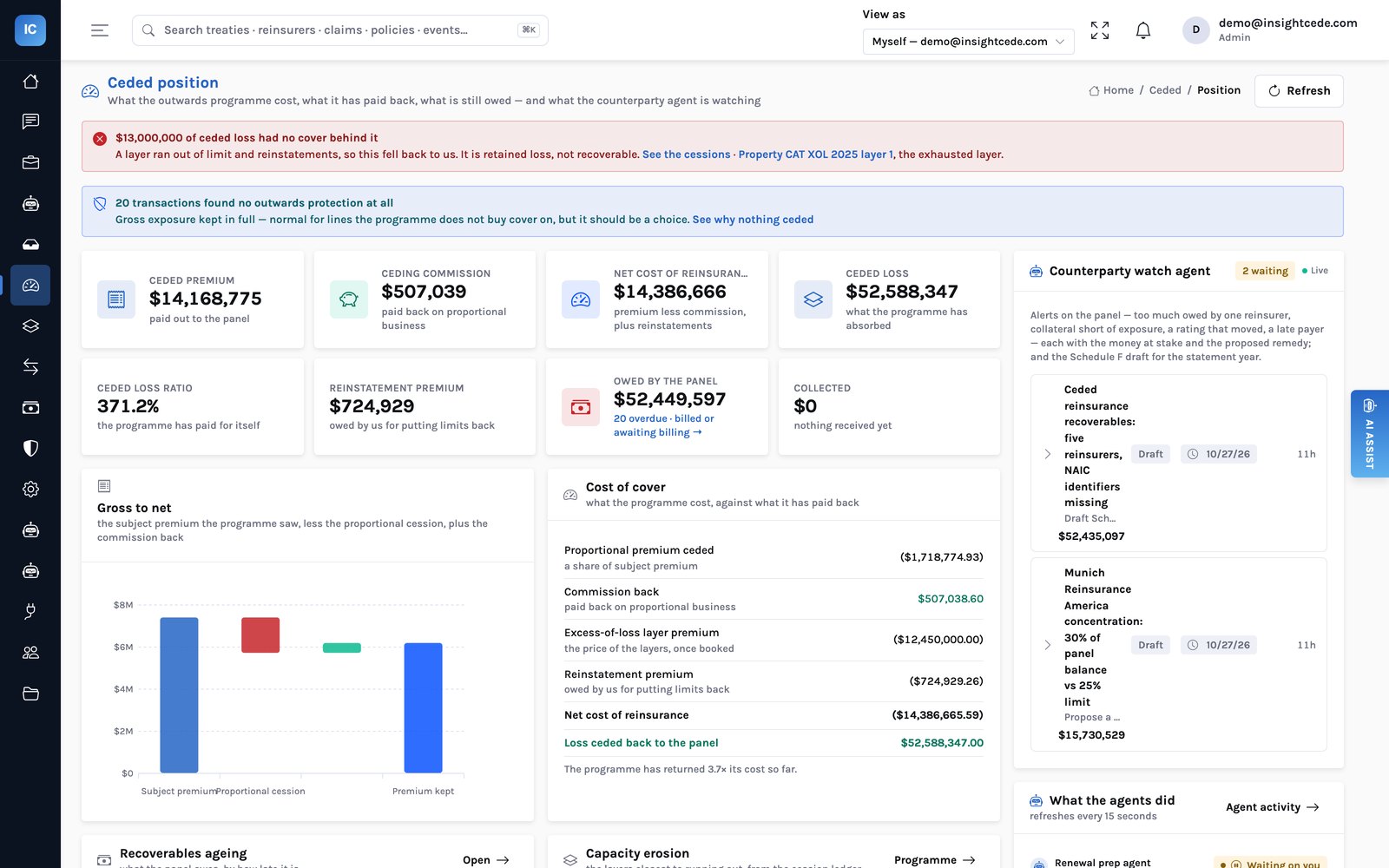
| Line on the demo position | Figure | Where it comes from |
|---|---|---|
| Subject premium | 7,425,545.00 | Gross premium the treaties were tested against on bind transactions |
| Ceded premium | 14,168,774.93 | Quota share cessions of 1,718,774.93, plus booked layer premium on the cat years |
| Ceding commission | 507,038.60 | 29.5% back on the quota share |
| Reinstatement premium | 724,929.26 | Owed by the carrier to reinstate eroded cat limits |
| Net cost of reinsurance | 14,386,665.59 | Ceded premium, less commission, plus reinstatement premium |
| Ceded loss | 52,588,347.00 | Outstanding plus paid, net of contra entries |
| Ceded loss ratio | 371.2% | Ceded loss over ceded premium |
| Uncovered and retained | 13,000,000.00 | A loss above an exhausted layer, kept by the carrier |
| Recoverable outstanding | 52,449,597.00 | Billed and unbilled, not yet collected |
Those are the demo programme's figures from the live position read — a demo US property-casualty carrier, not a customer, with one bad catastrophe year. Subject premium is smaller than ceded premium because most of the cost is cat layer premium, which is not a share of subject premium at all. The ratio is high because 2025 was the year the cat programme was bought for.
The CRO's question: who owes it, and are they good for it?
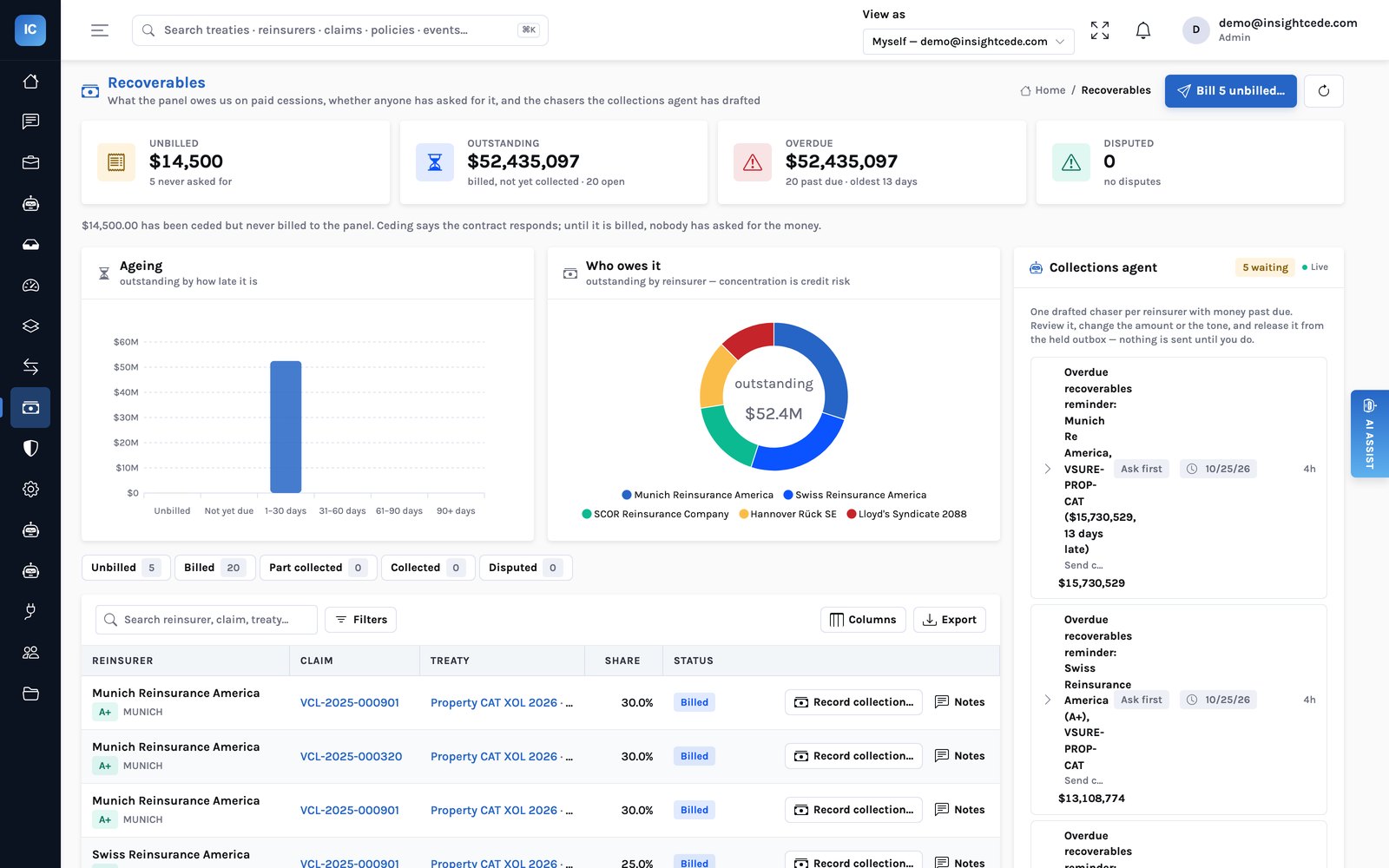
A cession says the contract responds. A recoverable is a claim against a named reinsurer for its share, and only that gets money back. The Recoverables page puts unbilled first, because unbilled is recoverable nobody has asked for, then outstanding, overdue and disputed, then the ageing and who holds the balance.
pie showData
    title Recoverable outstanding by reinsurer (demo, $)
    "Munich Re America (30% line)" : 15734879
    "Swiss Re America (25%)" : 13112399
    "SCOR (17.5%)" : 9178679
    "Hannover Re (15%)" : 7867440
    "Lloyd's 2088 (12.5%)" : 6556200
That chart carries the most useful insight in this post. The counterparty watch agent has an open proposal in the demo queue: Munich Reinsurance America holds 30.0% of what the panel owes, above the 25% concentration limit. It is true, and it is structural. A carrier whose recoverables come mostly from one programme will see each reinsurer's share of the balance converge on its signed line, so a 30% lead breaches a 25% limit by construction. The remedy is not a chaser. It is a decision about the limit, collateral, or the next placement, and the agent's proposal ends by asking the manager to choose.
Exhaustion is a risk number too
The other figure the CRO reads is capacity. The exhaustion watch agent's alert in the demo queue is on the 2025 property cat year's first layer: both limits used, its one reinstatement gone. Its scenarios are sized from the layer's own limit — a further loss of half the limit, the full limit, or twice the limit — and each shows the same answer, nothing ceded to that layer and the whole amount uncovered by it. The alert notes there is a second layer above and says the evidence does not show whether it would respond, so it assumes no recovery from it.
That restraint is the point. The alert does not price a back-up cover or guess at the second layer's response; it states what the ledger shows and proposes one thing to consider. The $13,000,000 already retained on the position is the same story told after the fact: a loss that reached a layer with nothing left, recorded with the reason “layer exhausted” rather than absorbed into net without comment.
Schedule F, as a draft
The Schedule F agent drafts the statement-year parts by reinsurer from the ledger: ceded premium and ceded loss (paid and outstanding) by each reinsurer's panel share, recoverables by age bucket — current, 1–90, 91–120 and over 120 days — disputed amounts, collateral held and the authorised flag, and a list of what is missing. It is an L1 draft: it is there to be reviewed, and accepting it applies nothing.
| Reinsurer | Ceded premium (2026 periods) | Recoverable, 1–90 days | Collateral | NAIC code |
|---|---|---|---|---|
| Munich Reinsurance America | 3,352,500 | 15,730,529 | 0 | missing |
| Swiss Reinsurance America | 2,793,750 | 13,108,774 | 0 | missing |
| SCOR Reinsurance Company | 1,955,625 | 9,176,142 | 0 | missing |
| Hannover Rück SE | 1,676,250 | 7,865,265 | 0 | missing |
| Lloyd's Syndicate 2088 | 1,396,875 | 6,554,387 | 0 | missing |
The draft in the demo queue is a good illustration of why it is a draft. Its premium column totals $11,175,000: three years of cat layer premium, because all three were booked in 2026 periods, and a part is scoped by the accounting period an amount was booked in. Its loss columns for 2026 are zero, because the 2025 cat losses were booked in 2025 periods, while the recoverables raised from them are still outstanding and appear in full. Every reinsurer is marked authorised with no collateral, and none has an NAIC identifier on file — the agent lists all five as missing rather than inventing one. Each of those is a question for the person signing the filing.
Net cost of reinsurance, ceded loss ratio, reinstatement premium owed, and what was retained above an exhausted layer. Wants every figure to reconcile to a statement.
Who owes what, how late, against what limit, with what rating and collateral, and what the news says about them. Wants the remedy to be a decision with a name on it.
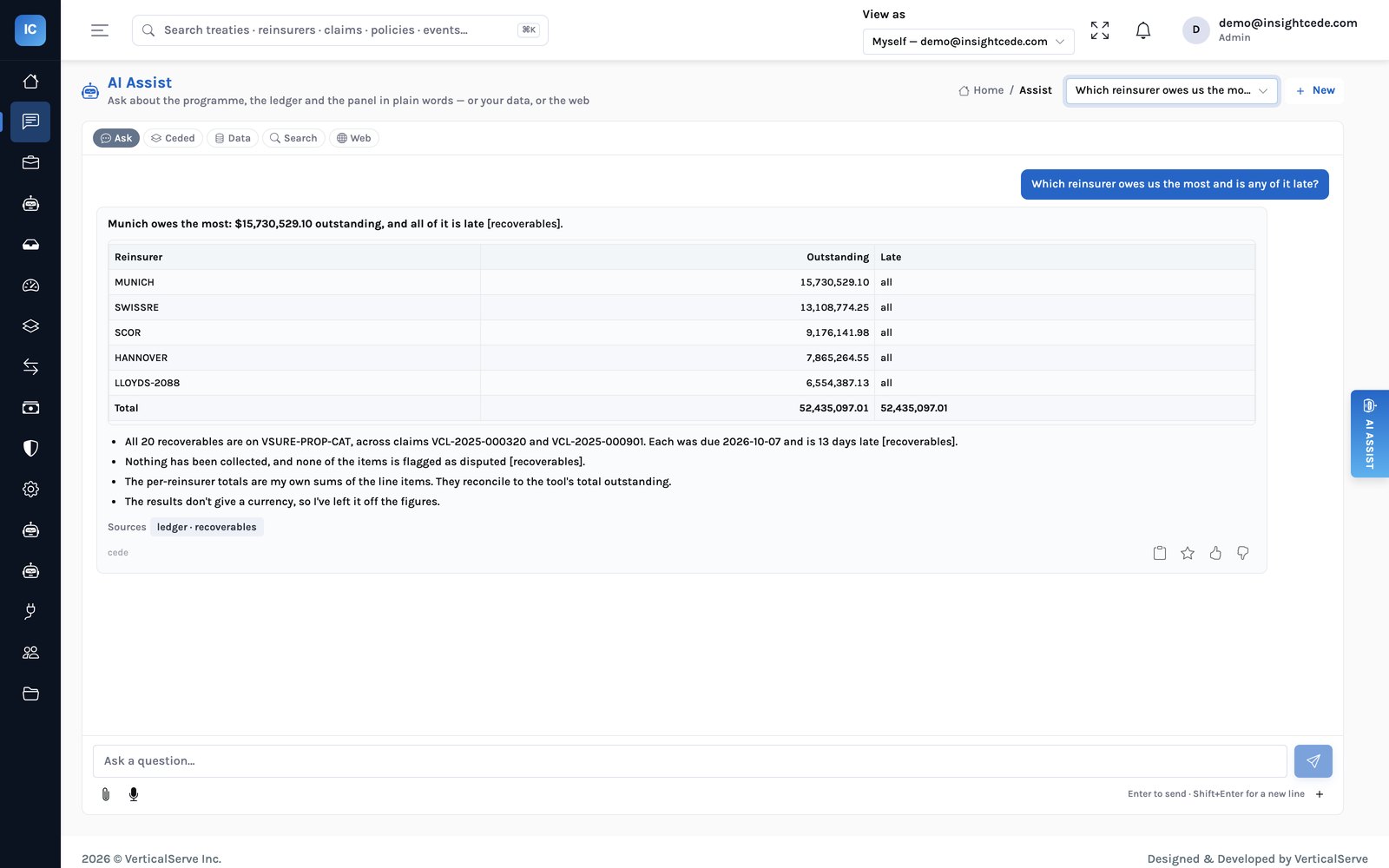
A 30% lead breaches a 25% limit by construction. The useful answer is a decision about the limit, not a reminder to the lead.
What it does not do
- Schedule F is not filed from here. The agent drafts the parts for review. There is no filing format and no export in the regulator's layout, and accepting the draft records agreement without applying anything.
- The master is taken on trust. Ratings, the authorised flag, collateral held and NAIC codes come from the reinsurer master as loaded. Cede flags what is missing; it does not verify what is there.
- No feed to the capital model. The published reads are the net position, a claim's net and recoverable ageing. A capital model takes them as an export, not through a contract built for it.
- Collections are recorded by a person. “Collected” on the demo position is $0 because no collection has been recorded. Until someone records the cash, every recoverable reads as owed.